
Service Design
Retail
2025
About The Project
IKEA is admired for its approach to design, affordability, and customer experience. Yet, the in-store checkout process often contradicted the brand’s promise. Customers commonly faced long lines, confusing Scan & Go systems, and the physical burden of scanning each product. What should be a simple last step became the most stressful, so many left with memories of friction rather than ease.
The Challenge
Research highlighted checkout as the most painful part of IKEA’s customer journey. Traditional checkouts took six minutes or longer for large baskets, especially at peak hours. Even Scan & Go, which was up to 65% faster, struggled to break 20% adoption. Customers called scanning “unpaid labor” and a skill they had to learn. Staff often had to step in for confused shoppers. The final customer impression was inefficiency and stress.
Research and Process
We led field observations and interviews across varied store formats to pinpoint pain points. Customers disliked logging into apps and scanning every item and wished they could scan everything all at once. Journey mapping consistently showed checkout as a bottleneck. Staff also confirmed the issue and noted that the task pulled them away from more valuable work.
To address these challenges, we benchmarked checkout methods, analyzed adoption rates, and co-created alternative flows with users and staff. Prototyping and journey mapping were core to the process, focusing on both technology and human experience.
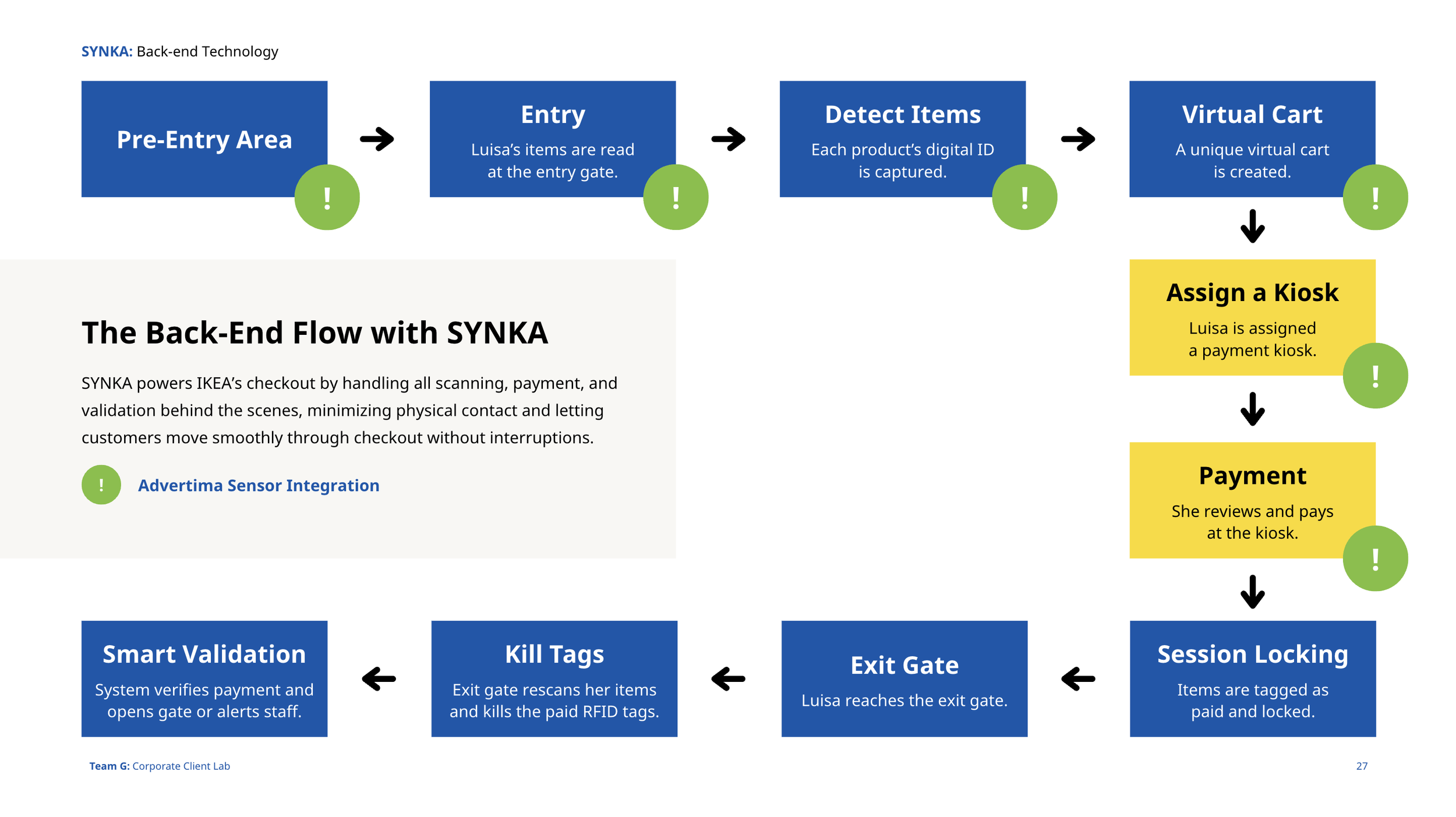
SYNKA Back-End Operational Flow
The Solution
Proposed Impact
The result: SYNKA, a scanless and RFID-powered checkout experience.
Customers place items in their carts, then walk through RFID-enabled gates.
Each product is automatically detected without any manual scanning.
A payment kiosk is assigned, where shoppers quickly review and pay.
Purchases and loyalty rewards sync instantly with the IKEA Family app.
Special RFID cards are issued for oversized items and managed by staff to ensure coverage and prevent loss.
Staff focus on RFID encoding and accuracy, and customer intervention is minimized.
The entire flow is seamless. It removes queues, reduces mental load, and lets shoppers finish with a stress-free experience.

SYNKA RFID Entry Gates

SYNKA Payment Kiosks
Key Learning
Painful touchpoints, even small ones, can overshadow the best experiences. Redesigning this critical moment protected IKEA’s brand promise and showed how human-centered technology can transform routine tasks into moments of delight. SYNKA demonstrates that operational efficiency and emotional impact can work together.

SYNKA Exit Gates
Based on benchmarks and projected adoption, SYNKA reduces the checkout journey from 6 minutes to just 2 minutes. This covers the entire process from entering the checkout area to exiting after payment. Compared to traditional methods, this is a reduction of more than 65% in checkout time and provides a seamless, stress-free experience for customers and staff. For personas like Luisa, a busy professional, SYNKA transforms the end of her IKEA trip into a quick and positive finale that matches the brand’s expectations.